

Welcome to CropVoice University
The information on this page is gathered from public sources and informed by InnerPlant’s data and experts to create a one-stop, authoritative source on crop disease.
Cercospora Leaf Blight
Cercospora leaf blight, caused by the pathogens Cercospora flagellaris or Cercospora kukuchii, is a fungus that can infect soybeans and threaten both the yield and seed quality of soybean crops. While it is found across most of the U.S. where soybeans are grown, Cercospora leaf blight is most commonly seen in the Southern and Midwestern states. Impact to yield is typically highest in the Southern U.S., where the warm, humid conditions are most conducive.
Disease Cycle
- Mycelia overwinter in infected crop residue
- When conditions are humid and between 75-80° F mycelia produce conidia, which spread by wind, rain splash, or irrigation
- Conidia infect soybean leaves, petioles and stems. In the presence of sunlight, the pathogen produces a toxin called cercosporin which causes plant cells to rupture
- Leaf lesions develop as leathery, bronze or purple discoloration in the upper canopy and progress to premature defoliation
- Sporulation from lesions cause secondary infections
- Purple seed stain may occur if pods become infected
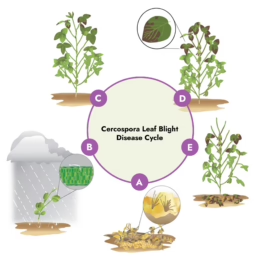
Cercospora leaf blight survives over winter in infected soybean residue. As temperatures rise to between 75-80° F and humidity increases, Cercospora leaf blight mycelia produce fungal spores, or conidia, that spread to new soybean tissue by wind, rain or irrigation.
Infected leaves, petioles, and stems may begin to show signs of disease late in the season, after the R1 growth stage. The pathogen that causes Cercospora leaf blight produces a toxin, called cercosporin, in the presence of sunlight, which causes plant cells to rupture. Because sunlight is critical for the toxin formation, leaves in the upper canopy typically show the most severe symptoms. Initial symptoms show as a leathery, purple or bronze discoloration on the uppermost leaves, petioles and stems. This discoloration can look like sun scorch.
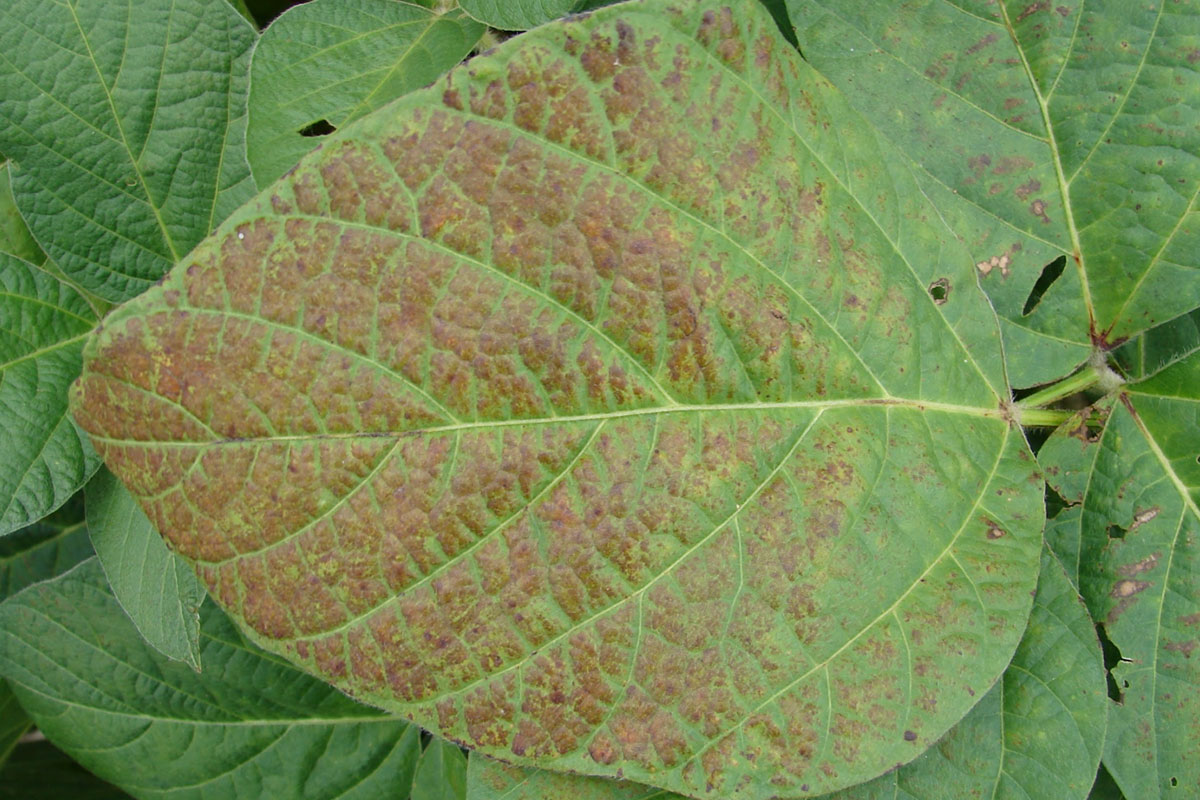
Lesions can eventually lead to premature defoliation, leaving only petioles attached to the stem. Premature defoliation reduces the plant’s ability to photosynthesize, which can cause shriveled and small seeds, and reduced yield.
If warm, humid conditions persist, new spores from infected plants can cause secondary infections. Fields with dense canopies are particularly vulnerable to severe late-season Cercospora leaf blight.
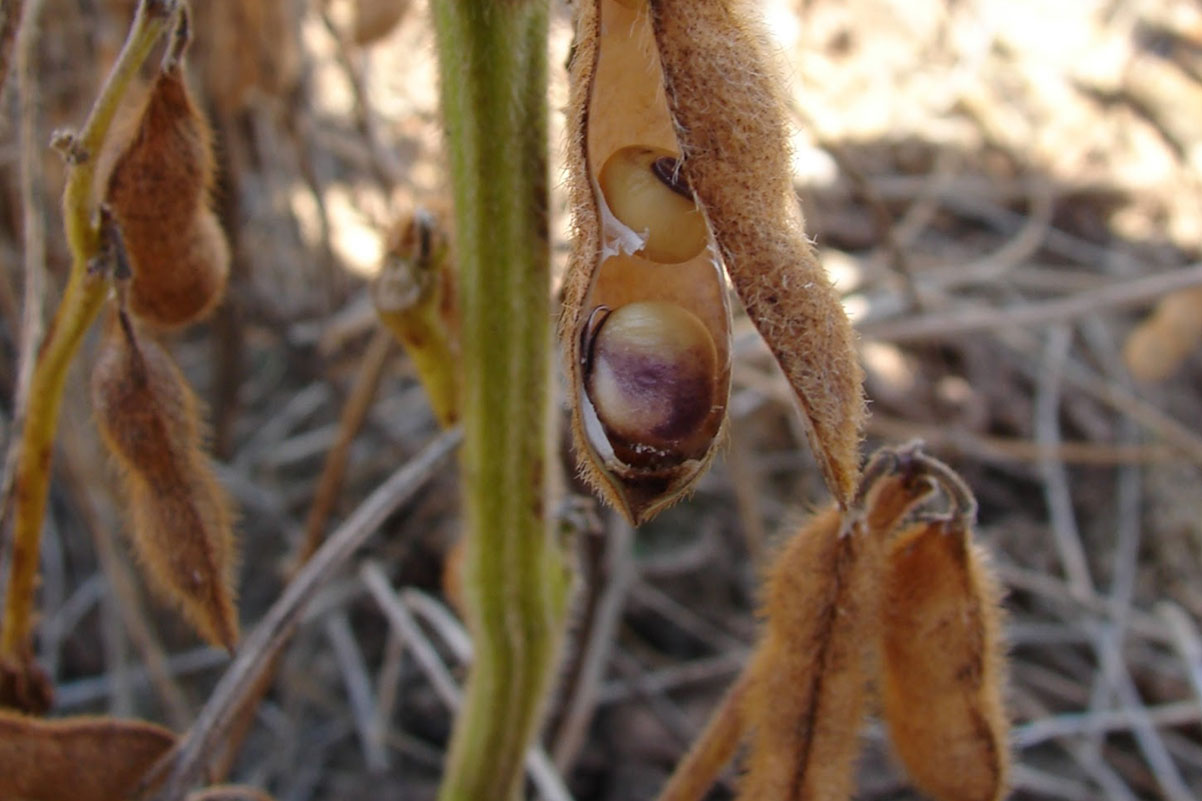
If infection spreads to the seed pods, the seed coat near the hilum will show a pink or purple discoloration, otherwise known as purple seed stain. If Cercospora leaf blight reaches this final stage, there’s a much higher chance it will survive into the next season.
While infected seeds can also carry the pathogen into the next year’s crop (not depicted on the graphic above), transmission from seed-to-seedling is less common.
Impact
Cercospora leaf blight can cause significant yield loss and reduced seed quality. In 2025, Cercospora leaf blight and purple seed stain led to an estimated yield loss of 6.1 million bushels, costing farmers over $63M (based on the USDA’s 2025/26 marketing year average price).
The yield impact of Cercospora leaf blight is directly related to the severity and timing of the upper-canopy defoliation.
Yield loss projections:
- Early and severe defoliation ➜ Significant yield loss and reduced seed quality
- Late season (after R6) or low severity ➜ Minimal yield loss
Managing Cercospora Leaf Blight
The best way to combat Cercospora leaf blight is an integrated management approach that includes in-season monitoring and timely in-season intervention when appropriate.
Before planting: Reduce your risk
When selecting soybean seed, choose certified, pathogen-free seed. If you have a field history of Cercospora leaf blight, work with your seed dealer to select soybean varieties that are more resistant to Cercospora leaf blight.
Late vegetative through early reproductive: Start monitoring conditions
Keep an eye out for warm (between 75-80° F), humid conditions and extended leaf wetness hours (more than 8 hours/day), which are ideal for Cercospora leaf blight development.
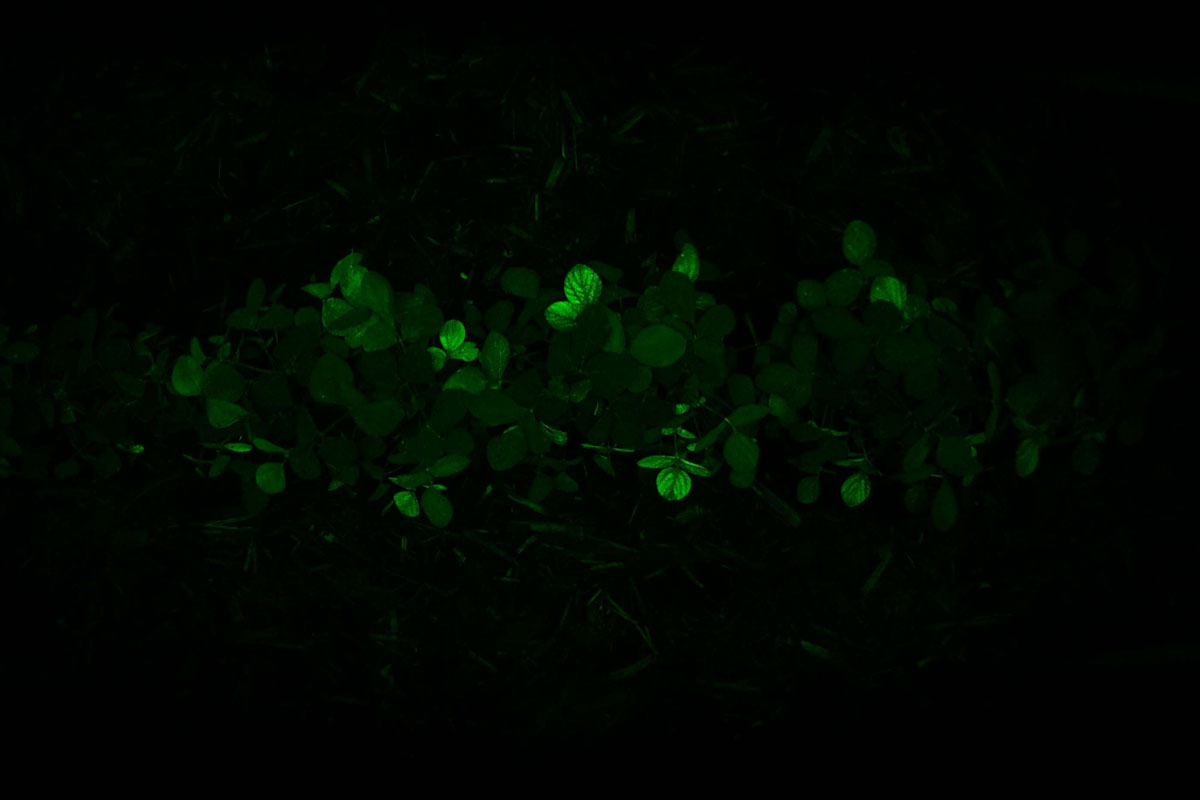
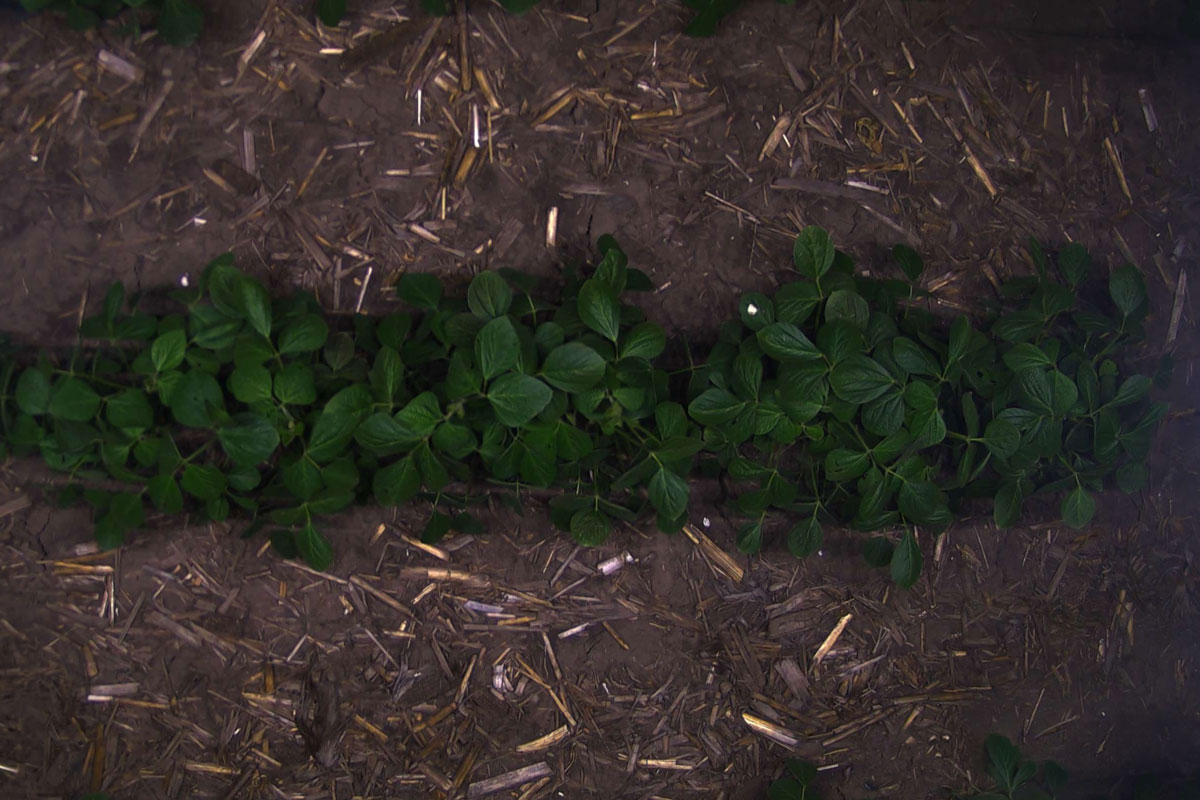
One simple way to detect Cercospora leaf blight before symptoms are visible is by using CropVoice. CropVoice scouting reports combine daily monitoring of InnerSoy™ (soybean plants engineered to signal when infected by fungus, like Cercospora leaf blight) with advanced models to forecast disease risk. CropVoice sends you a Disease Alert when there is confirmed Cercospora leaf blight infection near your fields
Reproductive (R3-R5): Actively monitor and manage your fields
Scout the upper canopy of your soybeans for the characteristic purple or bronze discoloration. Efficacy of fungicide application is highest when applied before significant symptoms appear.
Before applying fungicide, consider your farm’s specific risk factors, such as whether your fields have a history of Cercospora leaf blight and if the soybean varieties you planted are resistant to Cercospora leaf blight. Your cost of fungicide product and application will also determine the ROI of any application. Again, in many regions in the Upper Midwest, yield impact of Cercospora leaf blight is limited.
If you do decide to apply a foliar fungicide, ensure the product you select is labeled for use against Cercospora leaf blight and is effective. Recently, there has been increasing fungicide resistance documented for QoI (Group 11).
Late Reproductive (R6-R8): Track late-season infection
Monitor fields for severe defoliation, particularly in the upper canopy. While very severe Cercospora leaf blight can be confused with Sudden Death Syndrome, damage from Cercospora leaf blight typically starts in the upper canopy with reddish-purple or bronze discoloration, instead of the interveinal yellowing that characterizes Sudden Death Syndrome.
At this stage, fungicide application offers limited return on investment. Note any fields with Cercospora leaf blight and track the performance of your varieties for future crop rotations.
If you’d like to see how CropVoice can help your farm detect white mold before symptoms are scoutable on your farm, call (877) 418-2062 or send us a note at cropcoice@innerplant.com.
If you’d like to see how CropVoice can help your farm detect white mold before symptoms are scoutable on your farm, call (877) 418-2062 or send us a note at cropvoice@innerplant.com.