

Welcome to CropVoice University
The information on this page is gathered from public sources and informed by InnerPlant’s data and experts to create a one-stop, authoritative source on crop disease.
Septoria Brown Spot
Septoria brown spot, caused by the fungus Septoria glycines, is the most common soybean foliar disease. The disease can be found across most soybean-producing regions in the U.S., especially where soybeans are grown continuously.
Septoria brown spot thrives in warm, wet weather. Infection often occurs soon after planting, with symptoms becoming visible first in the lower canopy.
Disease Cycle
- Septoria glycines overwinters in infected crop residue
- Conidia spread by wind and rain to lower leaves of new plants
- Leaf lesions appear starting in the lower canopy. Infected leaves turn yellow, causing defoliation.
- Infection moves up plant canopy if warm, humid conditions persist
- Sporulation from lesions cause secondary infections
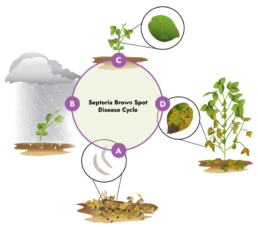
Septoria brown spot overwinters in infected soybean residue. In warm (60-85 ºF), humid conditions, Septoria brown spot fungal spores (conidia) spread by wind, rain, or irrigation. The infection starts in the lower canopy.
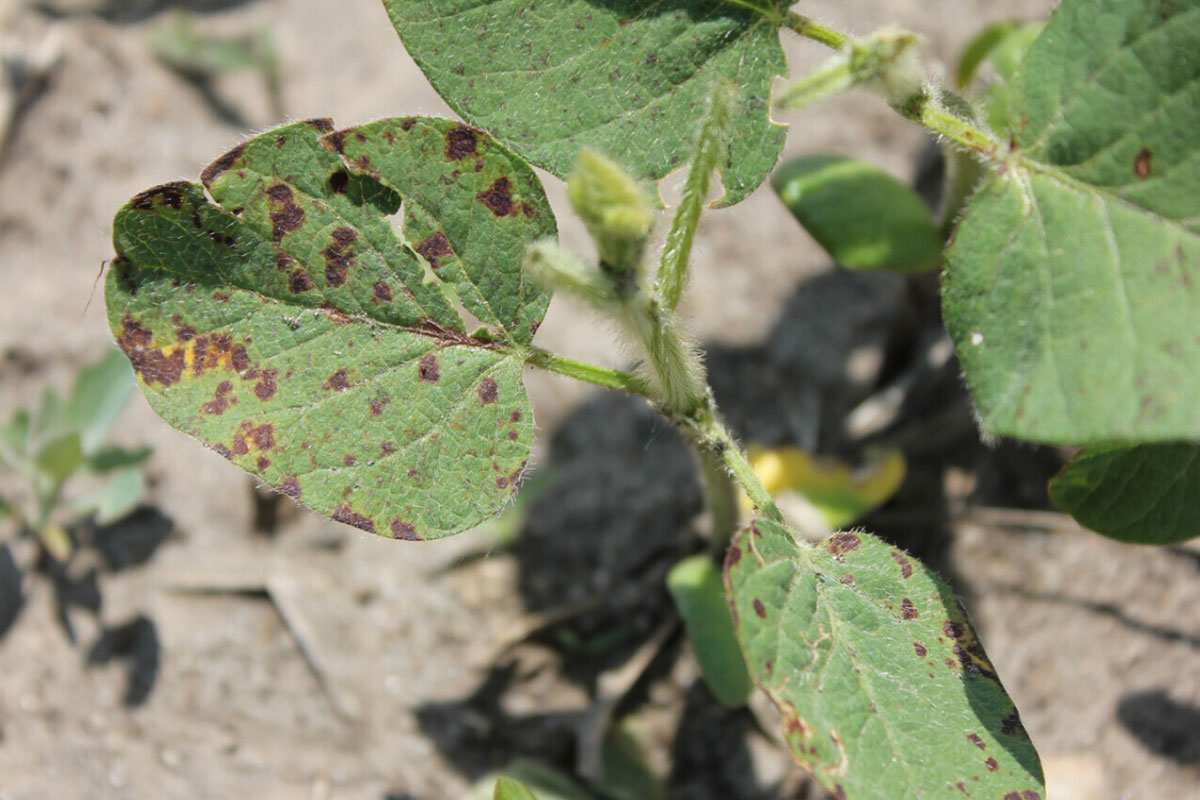
Symptoms typically first appear on young plants as small dark brown spots, sometimes with a yellow halo, on the unifoliolate leaves and will move further up the plant if warm, wet conditions continue. Lesions can spread to both the top and bottom of leaves, petioles and stems. Spots merge to form irregular brownish blotches. Infected leaves (typically in the lower to mid-canopy) turn yellow and drop. Symptoms for Septoria brown spot can easily be confused with bacterial blight. However, bacterial blight typically shows up on young leaves higher in the canopy while Septoria brown spot begins lower in the canopy.
The disease usually stops progressing in hot, dry conditions. New spores from infected plants can cause secondary infections in the same field.

Impact
Septoria brown spot can lead to yield reduction and premature defoliation, though significant yield loss is uncommon in the U.S. In 2025, Septoria brown spot resulted in an estimated yield loss of 1.5 million bushels, costing farmers over $15M (based on the USDA’s 2025/26 marketing year average price).
Yield loss from Septoria brown spot depends on how far up the canopy the disease progresses during podfill. The greatest yield loss is typically caused by severe early-season infection that leads to premature defoliation that spreads beyond the lower canopy.
Yield loss projections:
- Early and severe infection ➜ Reduce photosynthesis and slight yield loss
- Late season or low severity ➜ Minimal or no yield loss
Managing Septoria Brown Spot
Before planting: Reduce your risk
Understand which fields will be at highest risk for severe infection. Fields in low-lying areas with poor drainage or with a history of severe Septoria brown spot will likely be where Septoria shows up first. Additionally, fields with a history of other conditions like severe soybean cyst nematode damage or Fusarium root rot are at higher risk for Septoria brown spot.
While there are no varieties completely resistant to Septoria brown spot, if Septoria brown spot has been an issue for you in the past, work with your seed dealer to select soybean varieties that are less susceptible.
Vegetative stages (V1-Vn): Monitor for initial symptoms
Keep an eye out for warm, humid conditions, which are ideal for Septoria brown spot development. Monitor the lower canopy for the first signs of small, dark purple or brown spots.
One simple way to detect Septoria brown spot early is by using CropVoice. CropVoice sends you Disease Alerts when your crops are infected by monitoring daily InnerSoy™soybean plants engineered to signal when infected by fungus, like Septoria brown spot.
Reproductive Stages (R1-R5): Evaluate infection spread and treat if necessary
Check for disease becoming more severe and symptoms progressing up the plant. You can apply foliar fungicides from R3-R5 to limit infection spread to the middle to upper canopy during podfill. However, unless you see severe, early-season symptoms, applying fungicide might not be economically justified.
Late Reproductive (R6-R8): Track late-season infection
Monitor fields for premature defoliation. At this stage, fungicide application offers no benefit. Track the performance of your varieties for future crop rotations.
If you’d like to see how CropVoice can help your farm detect white mold before symptoms are scoutable on your farm, call (877) 418-2062 or send us a note at cropcoice@innerplant.com.
If you’d like to see how CropVoice can help your farm detect white mold before symptoms are scoutable on your farm, call (877) 418-2062 or send us a note at cropvoice@innerplant.com.