

July 10th, 2025 Scouting Report for Cedar, Knox, Pierce counties in Nebraska and Yankton County in South Dakota
(Scroll down for Illinois counties)
Reported by Tristan Mueller
Disease Risk: 🔴 High for 15” rows (no infection detected); 🟡 Moderate for 30” rows
Key Takeaways:
- High white mold risk for 15” and 20” rows.
- Low white mold risk for 30” rows with some areas of moderate risk in irrigated 30” rows in the east.
- There have not yet been visual symptoms of foliar diseases.
Scouting in the area has verified what the CropVoice plots have been telling us: there is an increase in white mold risk, though no infections have yet been confirmed.
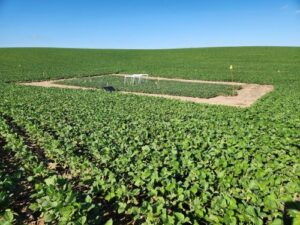
One of the CropVoice plots that is monitored daily.
Fields, for the most part, are looking clean from foliar disease. While some foliar diseases like Septoria brown spot are common this time of year, there have not been any visual symptoms of foliar diseases spotted this week.
Most of the soybeans scouted are late R1 to late R2, depending on the maturity planted and the planting date. This is a critical time when the plants are most at risk for the white mold pathogen to infect through the senescing flower.
Soybeans planted in 15” and 20” rows are mostly closed. With temperatures cooling off in the next week or two, if you have any moisture where the dew is not drying off quickly, there is a high risk of a white mold infection.
However, for 30” rows, for most of the beans you can still see the ground even though normally at this time of year, 30” rows would already be closed. The open rows let air move through the canopy which reduces the risk of a white mold infection.
Weather in the area has been fairly wet, but spotty, with some fields getting 2”+ of rain and others 0.1”. This variability in precipitation plays into the white mold risk, with fields that get more moisture being at higher risk of disease.
While there hasn’t been any signs of foliar disease during scouting, a few cases of phytophthora root and stem rot were observed. The lesion caused by the pathogen will girdle the stem and eventually cut off nutrients to the plant. There were very few infected plants (image below).
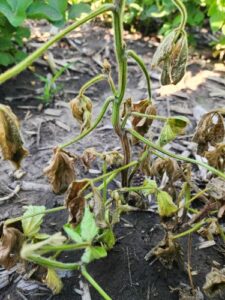
An advanced Phytophthora infection.
Looking ahead at the forecast, over the next week, all irrigated 15” rows will continue to be at high risk for white mold.

Forecasted white mold risk on irrigated 15” rows based on weather modeling. Red lines indicate major roads, with Highway 81 running down the middle of the image; Sioux City at right center.
Looking at the forecast for irrigated beans with 30” row spacing, moderate and high risk categories continue inching over from the east, up the Missouri River bottoms and most of the area still continuing to be in the low risk category.
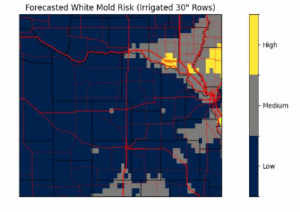
Forecasted white mold risk on irrigated 30” rows based on weather modeling. Red lines indicate major roads, with Highway 81 running down the middle of the image; Sioux City at right center.
If you have any questions about this report, feel free to reach out to your Customer Support Manager or our CropVoice help line at (877) 418-2062. The Crop Protection Network also just released a helpful tool: White Mold Fungicide ROI Calculator. As you are making your fungicide decision, talk with your local retailer.
July 10th, 2025 Scouting Report for Tazewell, Woodford, McLean, Livingston, and Champaign counties in Illinois
Reported by Robert “Bob” Starke, Ph.D.
Disease Risk: 🟢 Low for both 15” and 30” rows
Key Takeaways:
- Low disease risk: The CropVoice network continues to indicate low fungal growth based on data from twice-daily imaging of our sensor plots, tissue sampling, and scouting observations.
- Frogeye risk is expected to increase more in the eastern versus western portion of the five-county region over the next 10 days as the heat moderates.
Most soybeans scouted at the beginning of the week are in the R2 or early R3 stage. By next week, most fields will be into R3. Each field is a little different depending on planting date, moisture, and the maturity of the soybeans planted. Here is a great resource to accurately stage your soybeans.

One of the CropVoice plots that is monitored daily.
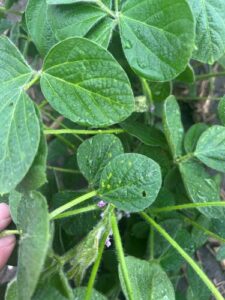
The CropVoice network continues to indicate low fungal growth based on data from imaging of our sensor plots, tissue sampling, and scouting observations. Some Septoria brown spot and a small amount of sudden death syndrome have shown up in tissue sampling. We are regularly seeing bacterial blight (not controlled by fungicides) in both the tissue sampling and scouting.
 ‘
‘
Bacterial blight on the trifoliate in the middle of the image (reddish yellow dots with black center).
Row spacing continues to have a major impact on the canopy as 30” rows are not yet fully closed and 15” rows have been closed for a couple of weeks. It is noticeably damper inside the canopy of the 15” rows later into the morning.
Most of the area received some showers on Tuesday, however soils remain relatively dry. The lack of moisture combined with the open canopies reduce the risk of disease.
Looking ahead, as the heat moderates, frogeye risk increases slightly. The change in frogeye risk over the next ten days ranges from about 4-5% increase in the eastern part of the region to a slight decrease in the western part of the region (pictured below). Over the next 10 days, there are more areas that will move from low risk to moderate risk.

Forecasted change in frogeye leaf spot disease risk for next 10 days based on weather, leaf moisture, and other variables. (Source: InnerPlant modeling based on the work of Damon Smith at the University of Wisconsin).
If you have any questions about this report, feel free to reach out to your Customer Support Manager or our CropVoice help line at (877) 418-2062. As you are making your fungicide decision, talk with your local retailer.
Catch up with any scouting reports you missed by following the links below:
Scouting Report for July 3, 2025
Scouting Report for June 26, 2025
Scouting Report for June 12, 2025
Scouting Report for May 29, 2025
Scouting Report for May 15, 2025