
Frequently Asked Questions
CropVoice FAQ
Everything you need to know about how CropVoice detects soybean disease, how the sensor network works, and how Disease Alerts reach your phone. Search below or browse by topic.
Printed
General Overview
What is CropVoice?
CropVoice helps farmers take control of disease in their fields by sending alerts when disease is present, weeks before symptoms are scoutable in fields. These text and email alerts are powered by a network of first-of-their-kind soybeans and corn engineered to signal only when there is an active infection. Farmers also receive access to a real-time Control Center to monitor the status of disease in their area and weekly scouting reports with agronomic insights.
What geographic areas does CropVoice currently cover?
CropVoice is currently available across key corn and soybean growing regions in the US Midwest. To find out if CropVoice is available in your specific area, call (877) 418-2062 or send us a note at CropVoice@InnerPlant.com.
How does CropVoice work?
Farmers receive access to a real-time Control Center to monitor the status of disease in their area and weekly scouting reports with agronomic insights.
Farmers also receive Disease Alerts when there is confirmed above-ground soybean or corn fungal disease near their fields. This alerts farmers to actual pathogens infecting real soybean or corn plants in their area. Customers choose to receive Disease Alerts directly to their phone via text message and email, or as a notification to their John Deere Operations Center.
Scouting reports and Disease Alerts are powered by a network of CropVoice plots monitored daily that feature InnerSoy™ and InnerCorn™ sensors, a soybean plant engineered to signal only when there is infection from pathogens that cause diseases like frogeye leaf spot or white mold. Farmers can get started with CropVoice by enrolling through their local retailer or seed dealer.
How does CropVoice confirm disease?
CropVoice uses InnerSoy and InnerCorn plants, the first-of-their-kind soybeans and corn engineered to signal when there is infection from above-ground fungal pathogens. Once the InnerSoy or InnerCorn plants signal infection, that information is supplemented with laboratory analysis, boots-on-the-ground scouting, local agronomic expertise, and advanced modeling and communicated to farmers through the CropVoice Control Center, text message, email, or John Deere Operations Center.
How do the InnerSoy and InnerCorn technologies work?
InnerSoy and InnerCorn plants are genetically engineered to fluoresce, or signal, when the plant's immune system responds to infection by fungal pathogens.
Can I buy InnerSoy seeds to plant in my own fields?
Insights from InnerSoy and InnerCorn are available exclusively through CropVoice today. InnerSoy and InnerCorn seeds are not available for purchase.
What crops are monitored by CropVoice?
CropVoice is available for soybeans to detect above-ground fungal disease. Starting in the 2027 growing season, CropVoice will also be available for corn.
What information do I need to provide to get started with CropVoice?
Once you let your retailer or seed dealer know that you'd like to purchase CropVoice, they will need the following information to get you enrolled:
- Farmer contact information (phone and email)
- Name of your farm operation
- John Deere Operations Center Account (if applicable)
- Field boundaries and crop type for your enrolled fields
You do not need to provide any additional information like soil sampling results, planting data, or field history.
How is farmer data protected?
InnerPlant takes a number of measures, both organizationally and technically, to reduce the risk of accidental disclosure or loss of personal data. You can find out more here. https://innerplant.com/about/privacy-policy/
Who do I contact for additional questions about CropVoice?
Contact your local retailer or seed dealer to enroll in CropVoice. If you are a customer already, every enrolled farmer has a dedicated Customer Success Manager to ensure you get the most out of CropVoice that you can contact directly. Additionally, you can always reach CropVoice support by emailing support@innerplant.com or calling (877) 418-2062.
Agronomic
How are CropVoice sensor plot locations selected?
CropVoice plots are selected to be representative of enrolled farmer practices and conditions. First, the data science team at InnerPlant analyzed historical data for CropVoice service areas, including: elevation, growing degree days, aridity index, root zone available water storage (to approximate soil quality), and seasonal temperature. Those variables were then used to create geographic “clusters,” or zones. Our Field Agronomists use this zone map with retail partners, farmer customers and Contract Research Organizations (CROs) to select final plot locations based on farmer management practices and field disease history.
Will there be one sensor plot for each farmer field that is enrolled?
No, CropVoice operates as a regional network rather than field-by-field deployment. The sensor plots combine to form the CropVoice network which provides disease insights for multiple surrounding fields. InnerPlant and its partners handle all plot setup, management, and monitoring to ensure reliable, high-quality Disease Alerts.
How dense is the CropVoice network?
The network is designed similarly to a cell tower network, with sensor plots placed strategically at a density that ensures reliable disease detection, with roughly one sensor plot per covered county.
How close to my farm will the sensor plot be?
Sensor plots are strategically placed based on several factors, so exact distances will vary but are optimized to provide reliable insights for participating farmers.
Will the sensor plot use similar practices as my fields?
CropVoice sensor plots are designed to match local farmer practices (e.g., planting date, row width, irrigation, tillage, relative maturity of the InnerSoy variety, etc.). Additionally, each sensor plot is planted with at least five different seed types to capture a breadth of different disease susceptibility profiles. The scouting report provided at the beginning of the season will include details on management practices used in the CropVoice network, and other agronomic factors that impact disease development.
Disease Alerts
How early does CropVoice detect disease compared to traditional scouting?
InnerSoy and InnerCorn are engineered to signal within hours of fungal infection. CropVoice delivers text alerts based on these signals, often weeks before symptoms are visible in fields.
How often will I receive Disease Alerts?
Farmers will receive a Disease Alert any time there is an active soybean disease detected that could impact their fields. Disease Alerts and scouting reports are provided during the growing season (after planting through August).
Does CropVoice detect all diseases and how specific is the disease detection?
CropVoice detects disease from above-ground fungal pathogens of soybeans and corn. Specific identification is provided for soybean diseases like white mold, Cercospora leaf blight, and frogeye leaf spot. For the 2027 season, specific identification of corn diseases will be provided if available.
How do farmers access CropVoice Disease Alerts and scouting reports?
Disease Alerts and Scouting Reports are delivered through text message, email, or the John Deere Operations Center to the contact information you provide when enrolling. New for 2027, the CropVoice Control Center will be available through any web browser for real-time information about disease impacting your fields.
No answers match .
Try a different keyword, or email support@innerplant.com.


Croptastic Episode 42: Charles C. Mann
This is a particularly exciting episode as we’re joined by Charles C. Mann, the New York Times bestselling author of “1491: New Revelations of the Americas Before Columbus,” and “1493: Uncovering the New World Columbus Created.” Charles shares insights with us about his more recent book, “The Wizard and the Prophet: Two Remarkable Scientists and Their Dueling Visions to Shape Tomorrow’s World,” and chats with Shely about the lessons the story of Norman Borlaug and William Vogt have for the future of agriculture.

InnerPlant Secures $300K from United Soybean Board for Satellite Detection of Crops Fluorescing When Stressed
InnerPlant Secures $300K from United Soybean Board for Satellite Detection of Crops Fluorescing When Stressed
Funds from the USDA’s soybean research and promotion program or “checkoff” will support the first-ever detection of human-made signals from soy plants when under attack by pathogens to make farmers more efficient and sustainable
DAVIS, Calif. (Sept. 14, 2023) – InnerPlant, the seed technology company enabling the earliest possible detection of stress in crops to make farming universally more efficient and sustainable, today announces $300K from the United Soybean Board (USB) for the satellite-based detection of crops fluorescing when under stress from pathogens. The funding supports the development, construction and validation of a first-of-its-kind satellite-mounted device to detect optical signals given off by crops engineered by InnerPlant to fluoresce in response to stress like an attack from pathogens or a lack of water or nutrients.
“Providing data directly from plants at the scale required by modern agriculture will give farmers critical knowledge they need to protect yields while reducing inputs,” explains Reza Bloomer, InnerPlant Director of Business Development. “The USB’s support shows their innovative and forward-thinking approach to ensuring that America’s soybean farmers have the best tools possible for their operations.”
The USB is funded by an assessment or “checkoff” collected from the net market price of soybeans and administers coordinated programs for promotion and research, as well as for collecting consumer and industry information related to soybeans.
Studies show that farmers lose as much as 20% of yields or $800B worldwide due to pathogens despite overapplication that sees as much as 30% or $250B of pesticides wasted – negatively impacting our air, water and soil.
Earlier detection and more responsive, plant-specific interventions offer a way to prevent waste and losses but historically farmers lacked early actionable data. Satellite-based detection provides a scalable way to give farmers the early warning they need to better care for crops and soils.
“The soybean checkoff is designed to advance the industry and help farmers improve their soybean operations,” points out Nancy Kavazanjian, a USB volunteer farmer director. “The ability to detect crop pest stress from space as much as weeks before any stress is visible to the human eye is an innovation that will deliver massively on those goals by helping us grow our soybeans more efficiently and sustainably.”
The InnerPlant imaging device is scheduled to launch in Q1 of 2024 and its successful deployment will mark the first time in history that a signal from a human-engineered organism is detected from orbit. In addition to supporting the launch, USB funds will also support additional related activities including field testing to validate orbital detection, procuring imagery from other public and private satellite operators and post-processing of signals. The entire suite of activities will culminate in the clear demonstration of satellite-based detection of human-made crop signals for the first time in history.
About InnerPlant
InnerPlant is a team of curious scientists and entrepreneurs creating an innovative new category of seed technology that harnesses plant physiology and unlocks data at scale to boost global agricultural yields and sustainability. The company was founded in 2018 by Shely Aronov and Rod Kumimoto. InnerPlant was recently recognized with a Special Mention TIME Best Inventions and was named a finalist in General Excellence by Fast Company’s World Changing Ideas Awards. For more information visit: innerplant.com.
Media Contact
Sean Yokomizo
Communications/Media Relations
sean.yokomizo@innerplant.com
925.878.1200

Croptastic Episode 27: David Wallerstein Big Solutions to Big Problems
David Wallerstein, Chief eXploration Officer and Senior Executive Vice President of Chinese Internet titan Tencent joins this Croptastic episode to talk about the need for big solutions to the planet’s biggest problems. His water-focused documentary, “Day Zero” is available on Amazon Prime.
Mr. Wallerstein has held a number of positions at Tencent since 2014 and Senior Executive Vice President since 2001. Mr. Wallerstein has also served as an independent member of Lilium board since September 2021.
Croptastic Episode 26: Dr. Rattan Lal on Soil and Water Conservation
Joining this Croptastic episode is Dr. Rattan Lal, Distinguished Professor of Soil Science and Director of the Carbon Management and Sequestration Center at The Ohio State University. He’s won many awards including the World Food Prize – the Nobel Prize of food and agriculture – in 2020.
Over his career spanning more than five decades and four continents, Dr. Lal has promoted innovative soil-saving techniques benefiting the livelihoods of more than 500 million smallholder farmers. We’re lucky to have Dr. Ratan Lal on this Croptastic episode.
Read Dr. Ratan Lal’s Journal of Soil and Water Conservation.
Croptastic Episode 25: Gonzalo Fuenzalida on Agricultural Biologicals
This Croptastic episode’s guest is Gonzalo Fuenzalida the CEO and co-founder of Andes Ag. Gonzalo joins the show to chat about agricultural biologicals and where they and other technologies fit in the future of agriculture.
Through its novel seed treatment technology, called ‘Microprime’, Andes is reducing the need for synthetic fertilizers. Gonzalo works to seamlessly integrate the power of microbes within seeds to dramatically cut the need for synthetic fertilizers.
Company genetically modifies plants to light up when facing stress – CGTN America
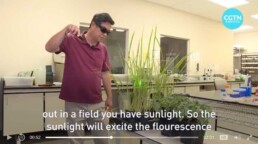
See how California startup InnerPlant has modified plants to light up when they are facing stressors.
The technology could greatly improve farming as 20-40 percent of global crop production is lost due to disease and invasive insects, according to UN data.
CGTN’s Mark Niu visits their labs.
Croptastic Episode 24: Kater Hake on the Cotton Farming
We’re joined this episode by Kater Hake, Vice President of Agricultural and Environmental Research at Cotton Incorporated. Today Kater and Shely chat about the state of cotton farming and some of the challenges that cotton and other crops face in the future.
In his current role, Kater is responsible for the cotton production research program, and leads a team of eight scientists who develop and support innovative problem-solving research to increase the profitability and sustainability of cotton farming in the U.S.