
July 17th, 2025 Scouting Report for Cedar, Knox, Pierce counties in Nebraska and Yankton County in South Dakota
(Scroll down for Illinois counties)
Reported by Tristan Mueller
Disease Risk: 🔴 High for white mold in both irrigated 15” and 30” soybeans.
Key Takeaways:
- Disease Alert was sent on Friday 7/11 for fields in Yankton County, SD and the northernmost edge of Cedar County, Nebraska.
- Not much other foliar disease pressure risk (like frogeye leaf spot) in the area.
When it comes to white mold in the CropVoice network area, there is a high disease risk for both 15” and 30” row spacing. For disease to take hold, you need all three sides of the disease triangle: host, pathogen, and environment.

Last Friday, we sent out a Disease Alert for Yankton County, SD and the northernmost edge of Cedar County, Nebraska. [View the full alert here.]
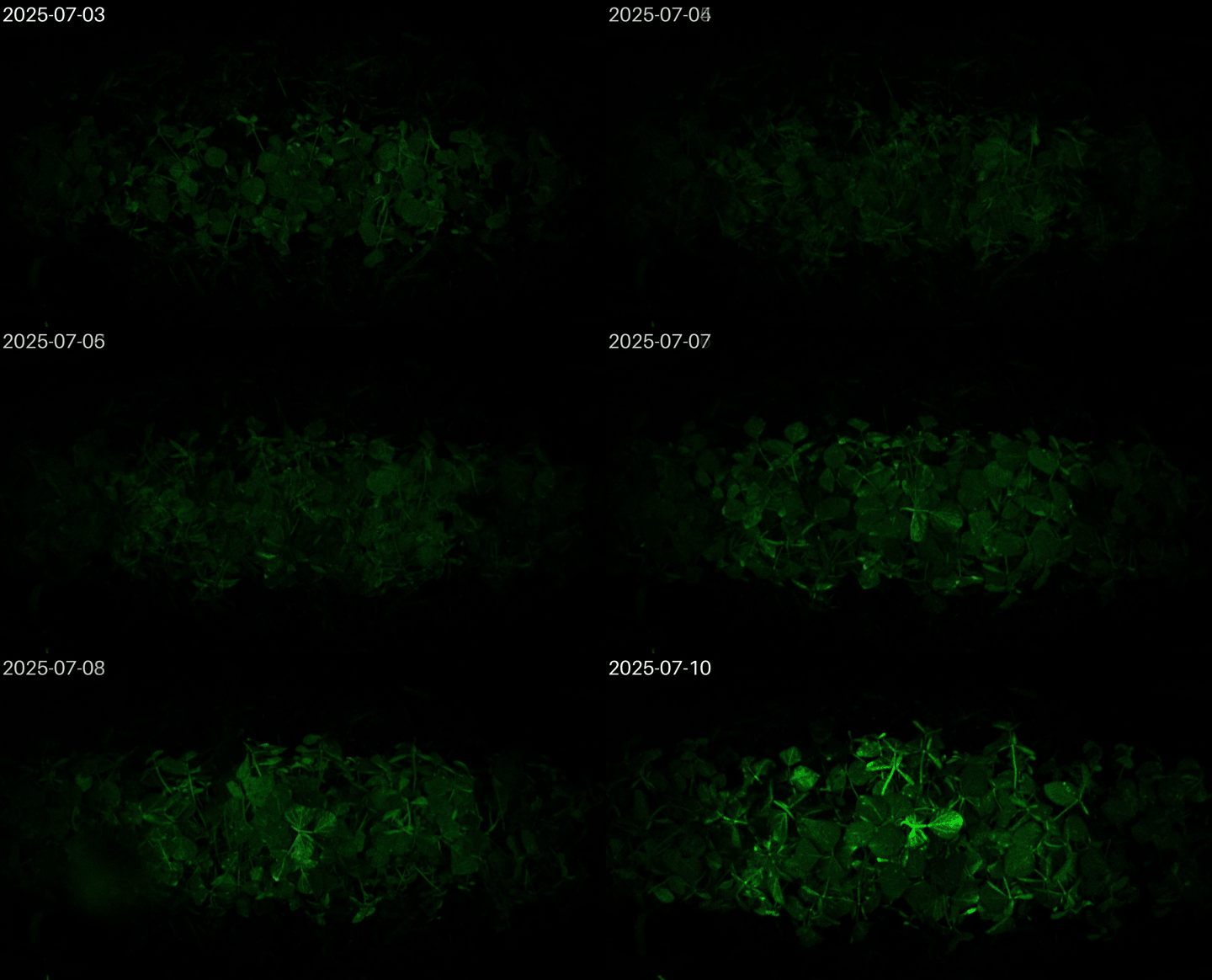
Caption: InnerSoy plants express an optical signal that brightens as infection triggers their immune systems
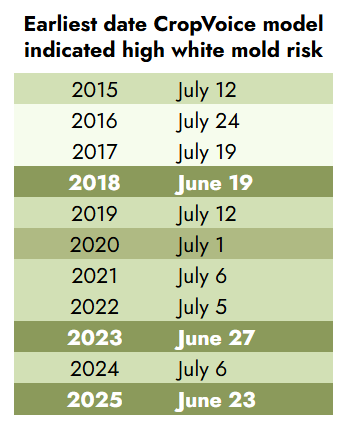
As noted in the Disease Alert, this year is the earliest we have reached the white mold high-risk category in 10 years for this region based on our CropVoice disease models, similar to previous years, like 2018 and 2023 which were historically difficult years for white mold. This high-risk timing coincides with most plants being at the R2 stage (flowering and flowering senescence) when infection can take hold.
Looking at the forecast, for irrigated beans with 15” row spacing, risk continues to be at the highest level both now and for the foreseeable future.
For irrigated beans with 30” row spacing, nearly all areas are either medium or high risk. The Osmond area, in particular, is a hotspot for high risk.

Caption: Forecasted white mold risk on irrigated 30” rows based on weather modeling. Red lines indicate major roads, with Highway 81 running down the middle of the image; Sioux City at right center.
If you do plan to spray a fungicide to control white mold at R2/R3, make sure that it has good efficacy to control white mold specifically (not all fungicides are created equal). Check out this White Mold ROI Calculator from the Crop Protection Network and talk with your retailer.
For other foliar diseases like frogeye leaf spot, the CropVoice network has not indicated much disease pressure risk in the area.
July 17th, 2025 Scouting Report for Tazewell, Woodford, McLean, Livingston, and Champaign counties in Illinois
Reported by Robert “Bob” Starke, Ph.D.
Disease Risk: 🟢 Low
Key Takeaways:
- Indication of common diseases that are typical for this time of year and have minimal yield impact, like Cercospora leaf blight and Septoria brown spot
- With R3/R4 soybeans, there are fewer opportunities left for white mold to take hold
Soybeans are into late R3 and early R4. Most flowering is moving to the top of the plants, and there are fewer dead flowers. Fewer dead flowers means that there are fewer entry points for white mold to take hold. The key period for white mold infection is closing in most fields for the year.
Especially for those narrow rows that have been closed for the past three to four weeks, more yellowing and disease symptomatology is becoming visible. Most plants have a few yellow leaves near the bottom as expected this time of year.
We are seeing Cercospora leaf blight in at least one CropVoice plot (pictured below). In the South, this disease can be yield-robbing. Typically in the Midwest, however, Cercospora leaf blight has limited yield impact (especially at the levels we are detecting). We are continuing to monitor closely and will send a Disease Alert if the Cercospora leaf blight begins to threaten yields.

Caption: Fluorescent images from one of the Illinois CropVoice plots over the course of 6 days. InnerSoy plants express an optical signal that brightens as infection triggers their immune systems

Caption: Cercospora leaf blight symptoms
Other common diseases that are typical for this time of year and have minimal yield impact are coming up in scouting and tissue samples, including Septoria brown spot and downy mildew. Downy mildew is not controllable by fungicide.

Caption: Downy mildew symptoms
Over the next ten days, the change in frogeye leaf spot risk increases by 3.5% on average across the region (pictured below).
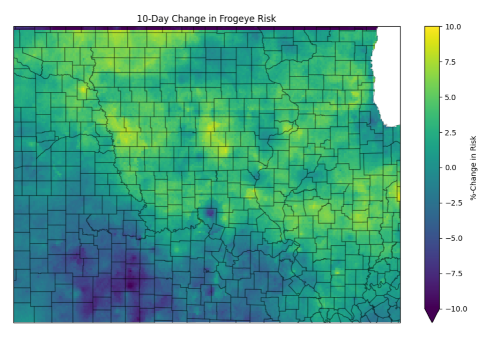
Caption: Forecasted change in frogeye leaf spot disease risk for next 10 days based on weather, leaf moisture, and other variables. (Source: InnerPlant modeling based on the work of Damon Smith at the University of Wisconsin)
If you have any questions about this report, feel free to reach out to your Customer Support Manager or our CropVoice help line at (877) 418-2062. As you are making your fungicide decision, talk with your local retailer.
Catch up with any scouting reports you missed by following the links below:
Disease Alert for July 11, 2025
Scouting Report for July 10, 2025
Scouting Report for July 3, 2025
Scouting Report for June 26, 2025
Scouting Report for June 12, 2025
Scouting Report for May 29, 2025
Scouting Report for May 15, 2025