
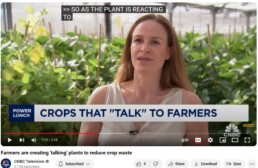
This Startup Helps Plants Talk to Farmers, Reducing Pesticides and Agricultural Waste
(original video report and article available at CNBC.com)
What if plants could talk to farmers and tell them when they’re distressed? That would not only help the plants but also reduce the amount of agricultural waste that threatens the planet’s health.
Much of agriculture may look green, but the industry is one of the world’s biggest carbon offenders. It accounts for at least 10% of global greenhouse gas emissions, according to 2021 data from the Environmental Protection Agency. Agricultural waste adds to the problem.
Even with the use of pesticides, up to 40% of most food crops globally are lost to disease and pests, according to data from the Food and Agriculture Organization of the United States cited in a 2023 report from the National Institute of Food and Agriculture. Now companies like SatAgro, Climate FieldView, and a California-based startup called InnerPlant are working to reduce agricultural waste.
Using genetic engineering, InnerPlant helps crops communicate with their farmers. The technology uses fluorescents that emit a signal in the leaves when a plant is in distress. That signal is detectable from devices that can be attached to satellites, drones or tractors.
“As the plant is reacting to the stresses in your environment, like fungal pressure insects or nitrogen deficiency, it will start to signal and then we can help farmers understand what areas of the field need something and what areas are fine and don’t need additional chemicals,” said Shely Aronov, CEO of InnerPlant.
From that signal, farmers know what to treat, meaning they don’t waste money on chemicals, which are over-applied by up to 30%, Aronov said.
“We want to eliminate all the unnecessary applications of chemicals into our food system, into our soils, and also the additional cost that comes to farmers that they don’t get any benefit from,” added Aronov.
This technology is highly scalable and could be licensed to major seed companies. InnerPlant would earn royalty revenue, which makes it enticing to investors.
“If you can get this technology into every single corn seed or soybean seed across North America and South America, that is many hundred millions of acres, and you can think about a few dollars per acre from a revenue perspective. That all of a sudden ends up in a lot of revenue for this business,” said Tom Biegala, founding partner of Bison Ventures, an InnerPlant investor.
In addition to Bison Ventures, InnerPlant is backed by John Deere, MS&AD Ventures, UpWest VC and Bee Partners. It has $22.3 million in total funding.
InnerPlant is now working closely with small farmers and some of the nation’s largest agriculture producers. Some have paid to get early access to the technology, which will start with soybeans and then expand to other crops.


InnerPlant CEO Shely Aronov is developing crops that communicate

(From the Sacramento Business Journal - click here for original coverage with subscription)
Shely Aronov’s Davis-based company InnerPlant is bringing to market fluorescing plant trait technology to help farmers get higher yields using fewer expensive chemicals by pinpointing early on where in the field crops need help.
The target crop is soybeans, which tend to be grown in vast acreage, so pinpointing problems allows farmers to use a little chemical where it is needed rather than broadcasting chemicals over hundreds or thousands of acres.
(Article continues at the Sacramento Business Journal with subscription)
InnerPlant Named to Fast Company’s Annual List of the World’s Most Innovative Companies of 2024
The company helping crops communicate their needs to farmers joins the ranks of Nvidia, YouTube, Taco Bell, and more
DAVIS, Calif. (March 19, 2024) — InnerPlant has been named to Fast Company’s prestigious list of the World’s Most Innovative Companies of 2024.
This year’s list shines a spotlight on businesses that are shaping industry and culture through their innovations. These organizations are setting new standards and achieving remarkable milestones in all sectors of the economy. Alongside the World's 50 Most Innovative Companies, Fast Company recognizes 606 organizations across 58 sectors and regions.
“Agriculture is an industry that affects every person on the planet and innovation is critical to ensuring that we can produce food efficiently and sustainably,” points out Shely Aronov, InnerPlant’s CEO and co-founder. “For the first time in the 10,000-year history of agriculture, plants will directly communicate their needs to farmers so yields are protected and waste and environmental impacts are reduced.”
InnerPlant creates crops that emit light at specific wavelengths when they’re thirsty or sick. The signals are detectable from as far away as space and provide farmers with the earliest possible indication of crop stress that’s weeks before symptoms can be seen in the field.
The company recently announced a partnership with Syngenta - a global leader in agricultural innovation and crop protection - and John Deere - a global leader in the delivery of agricultural, construction, and forestry equipment - to develop an integrated solution to fight fungus in soybeans. The first-of-its-kind solution will link together plants that give off early and specific signals when under attack by fungus with optimized crop protection treatments that are precisely delivered with See & Spray technology.
This spring, 2024, InnerSoy - a soybean fungal sensor - is rolling out in Illinois fields in partnership with Growmark, an agricultural cooperative serving almost 400,000 customers across North America.
The World's Most Innovative Companies stands as Fast Company's hallmark franchise and one of its most anticipated editorial efforts of the year.
Fast Company's editors and writers identified the companies driving progress around the world and across industries, evaluating thousands of submissions through a competitive application process. The result is a globe-spanning guide to innovation today, from early-stage startups to some of the most valuable companies in the world. Fast Company’s Most Innovative Companies package is available online, as well as in-app form via iTunes, and on newsstands beginning March 26. The hashtag is #FCMostInnovative.
“Our list of the Most Innovative Companies is both a comprehensive look at the innovation economy and a snapshot of the business trends that defined the year,” said Fast Company editor-in-chief Brendan Vaughan. “We saw extraordinary innovation across the board in 2023, but we also saw a handful of clear patterns: the growing footprint and impact of AI, the triumphant return of live events, and great leaps forward in climate tech. We face daunting challenges on many fronts, but the solutions we celebrate in MIC give me plenty of hope about the future.”
Fast Company will host the Most Innovative Companies Summit and Gala on May 16. The summit features a morning and afternoon of inspiring content, followed by a creative black-tie gala including networking, a seated dinner, and an honoree presentation. This event celebrates the Most Innovative Companies honorees and provides an inside look at cutting-edge business trends and what it takes to innovate in 2024.
About Inner Plant
InnerPlant is a team of curious scientists and entrepreneurs creating innovative traits that harness plant physiology and unlock data at scale to boost global agricultural yields and sustainability. The company was founded in 2018 by Shely Aronov and Rod Kumimoto. InnerPlant was previously recognized with a Special Mention TIME Best Inventions and was named a finalist in General Excellence by Fast Company’s World Changing Ideas Awards.
About Fast Company
Fast Company is the only media brand fully dedicated to the vital intersection of business, innovation, and design, engaging the most influential leaders, companies, and thinkers on the future of business. Headquartered in New York City, Fast Company is published by Mansueto Ventures LLC, along with our sister publication Inc., and can be found online at www.fastcompany.com.
Media Contact
Sean Yokomizo
Communications/Media Relations
sean.yokomizo@innerplant.com
925.878.1200
###

InnerPlant Wins 2024 Impact 100 Award
Winners from thousands of entries are evaluated via competitive judging and employee feedback to select the 100 most impactful companies to work for across the globe
DAVIS, Calif. (Feb. 21, 2024) – InnerPlant, the seed technology company enabling the earliest possible detection of stress in crops to make farming more efficient and sustainable, was selected as a winner of the 2024 Impact 100 Award by Hyer, the on-demand labor app and analytics firm. The award recognizes the most impactful companies to work for across the globe and honors their commitments to positive missions and building a progressive, people-first workplace.
“InnerPlant is careful to align our mission of transforming agriculture by enabling crops to communicate with the values of our team to create a positive and impactful workplace,” explains Dan Garblik, Senior Vice President of Operations and Finance. “The fact that employee feedback was a factor in our winning this award is especially humbling and gratifying.”
Hyer’s selection process reviews thousands of companies of all sizes and interviewed over 20,000 employees to uncover the companies making a true impact - where all employees, from top to bottom, genuinely feel like their contributions are making a difference to a cause they care about.
Along with an in-depth review of current and future measurements, and initiatives, the award organizers conduct anonymous internal surveys with a specific set of open-ended questions designed to uncover how employees truly feel about their company, without the bias company leaders might promote.
The ranking system consists of two categories of questions: closed-ended and open-ended. Closed-ended responses include single-answer questions, and an analysis of the percentage of employees within each company that participated in the survey. The percentage of respondents per company is factored into the final analysis. The survey is a 'sentiment' analysis, where the vast majority of the weight is placed on the open-ended responses.
Once the survey is complete, all responses are analyzed, datasets are normalized, and bespoke weighting is applied to each category to derive a single score for each company.
About InnerPlant
InnerPlant is a seed technology company that enables the earliest detection of pathogens and other stresses in key crops to make farming universally more efficient and sustainable. The company was founded in  2018 by Shely Aronov and Rod Kumimoto. InnerPlant was recently recognized with a Special Mention TIME Best Inventions and was named a finalist in General Excellence by Fast Company’s World Changing Ideas Awards. For more information visit: innerplant.com.
Media Contact
Sean Yokomizo
Communications/Media Relations
sean.yokomizo@innerplant.com
925.878.1200
###
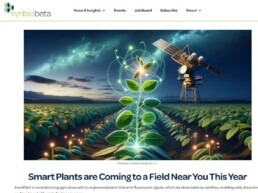
Smart Plants Are Coming to a Field Near You This Year
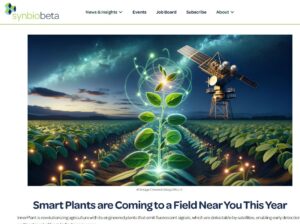
(From Synbiobeta - click here for original coverage)
Despite your painstaking efforts to pick perfect produce, you didn’t notice the tiny bit of mold growing on that one strawberry on your weekend grocery stock-up. By Friday, you’ve got a full-on fuzz fest on your hands.
Fungus spreads fast, even in your fridge. And your mushy strawberries were the lucky ones. Plenty of their neighbors died in the field, never to produce a fruit.
The Costly Impact of Fungal Diseases in Agriculture
Fungi are responsible for about 80% of plant diseases, resulting in $100-200 Billion in losses annually in the United States alone. What’s worse, some fungi produce toxins that are harmful to humans and livestock.
So, what’s a farmer to do? Fortunately, we have fungicides. Fields are treated with fungicides—yes, organic ones, too—when a fungal outbreak appears.
But spraying a field with fungicide once we see fungus is like giving an entire elementary school antibiotics because a few kindergarteners have pink eye. We know from experience that every one of those booger eaters is likely to end up with pink eye, but broad-scale antibiotics hardly seem like a good solution. What if we could know when a kid gets pink eye before he has any symptoms and treat him before he’s ever contagious?
A New Approach to Combat Fungal Infections
That is what InnerPlant does for farmers. “We make crops that can communicate,” said Shely Aronov, CEO and Co-Founder of InnerPlant. And they’re coming to a field near you next year.
(Article continues at Synbiobeta)

InnerPlant Hires Syngenta Alum / Ex-Enko VP of Corp Development to Lead Charge Toward Commercialization
Gary Schaefer joins as VP of Revenue + Partnerships to build on existing partnerships and expand commercial opportunities for crops that signal optically when under stress
DAVIS, Calif. (Dec. 14, 2023) – InnerPlant, the seed technology company enabling the earliest possible detection of stress in crops to make farming more efficient and sustainable, today announces the hiring of veteran agtech executive Gary Schaefer to the role of Vice President of Revenue and Partnerships. Schaefer will lead the team driving the commercialization of InnerPlant’s technology and build on the company’s traction around industry partnerships.
“My career has always centered on helping deliver ways to solve problems for farmers and make their work easier and more efficient,” says Schaefer. “I’m excited by the opportunity to expand InnerPlant’s alliances and build new ones to leverage their unique and powerful data for the benefit of farmers and the industry.”
Schaefer was most recently the Vice President of Corporate Development for agtech startup Enko following executive roles at crop-protection firms Syngenta and Valent. He holds a BS in Food and Resource Economics, as well as a Masters of Agribusiness from the University of Florida.
Today’s news comes on the heels of InnerPlant’s recent announcement of its partnership with John Deere and Syngenta, as well as the launch of a fungal sensor pilot program with GROWMARK, an agricultural cooperative with over 400,000 customers.
About InnerPlant
InnerPlant is a seed technology company that enables the earliest detection of pathogens and other stresses in key crops to make farming universally more efficient and sustainable. The company was founded in 2018 by Shely Aronov and Rod Kumimoto. InnerPlant was recently recognized with a Special Mention TIME Best Inventions and was named a finalist in General Excellence by Fast Company’s World Changing Ideas Awards. For more information visit: innerplant.com.
Media Contact
Sean Yokomizo
Communications/Media Relations
sean.yokomizo@innerplant.com
925.878.1200
###

COP28 Panel: "Mood Beans:" How digitization of crop stress accelerates resiliency and sustainability of global agriculture
 (click to watch)
Shely traveled to Dubai for the UN's premier climate conference COP28 to participate in a panel as part of the Global Innovation Hub in the event's Blue Zone.
The panel included Ben Chostner from John Deere/Blue River, Zachary Mitschrich from GIC, and moderator Guy Hudson from Loam Bio.
You can view a recording of the panel here.
InnerPlant + GROWMARK Launch Sentinel Project Featuring Soybean Engineered to Signal Optically When Stressed
Program to see small plots of InnerSoy throughout the Midwest in 2024 acting as “sentinels” to provide early warning of fungal infestation and charting path to a wider rollout
DAVIS, Calif. (Nov. 30, 2023) – InnerPlant, the seed technology company enabling the earliest possible detection of stress in crops to make farming more efficient and sustainable, and GROWMARK, an agricultural cooperative serving almost 400,000 customers across North America, today announce the launch of a sentinel project featuring InnerSoy, a soybean engineered to signal optically when under attack by fungi.
The program will see GROWMARK establish small plots of InnerSoy throughout the Midwest in 2024 with an expanded number of plots over the next three years. The plots will act as “sentinels” to provide early warning of fungal infestation and help refine InnerPlant’s initial go-to-market strategy.
“GROWMARK’s focus on providing farmers with the tools they need to efficiently and sustainably feed the world makes them an ideal partner for our in-field pilot,” explains Dan Garblik, InnerPlant’s Senior Vice President of Operations and Finance. “Working with their experts will help us explore ways we can provide value to their farmer customers, as well as understand and optimize real-world operations.”
InnerPlant genetically engineers plants to emit optical signals when the plants are stressed from a lack of water or nutrients or under attack from pathogens, like fungi. The signals are detectable from as far away as space and show stress as much as two weeks before existing technologies giving farmers the earliest warning possible to optimize action and protect their crops.
The program will establish a number of sentinel plots located near production soybean farms to provide precision scouting and improved agronomic intelligence. As a trusted advisor to farmers, GROWMARK will use the improved data to augment existing tools, such as spore cams, remote sensing, and manual in-field scouting to make better prescriptions and crop protection recommendations.
”Farmers face a tremendous amount of risk from the weather, geopolitical events, and pathogens,” points out GROWMARK CEO Mark Orr. “This pilot gives our farmer-customers first access to cutting-edge technology that taps directly into plant physiology to give them critical data they need to mitigate some of that risk and better protect their crops.”
Data gathered during the sentinel program will demonstrate the value of early detection and early action of InnerSoy that will enable plant-by-plant management.
About InnerPlant
InnerPlant is a seed technology company that enables the earliest detection of pathogens and other stresses in key crops to make farming universally more efficient and sustainable. The company was founded in 2018 by Shely Aronov and Rod Kumimoto. InnerPlant was recently recognized with a Special Mention TIME Best Inventions and was named a finalist in General Excellence by Fast Company’s World Changing Ideas Awards. For more information visit: innerplant.com.
About Growmark, Inc.
GROWMARK is an agricultural cooperative serving almost 400,000 customers across North America, providing agronomy, energy, facility engineering and construction, and logistics products and services, as well as grain marketing and risk management services. Headquartered in Bloomington, Illinois, GROWMARK owns the FS trademark, which is used by member cooperatives. More information is available at growmark.com.
Media Contact
Sean Yokomizo
Communications/Media Relations
sean.yokomizo@innerplant.com
925.878.1200
###
InnerPlant, John Deere Expand Ecosystem to Include Syngenta, Focusing on the Evolution towards Plant by Plant Disease Management
New ecosystem collaboration sets out to change how plant disease is managed
(from Upstream Ag Insights, published with permission. Images and charts removed - fully formatted version is available with subscription here)
SHANE THOMAS NOV 11, 2023
InnerPlant, the seed technology company enabling the earliest possible detection of stress in crops to make farming universally more efficient and sustainable, Syngenta, a global leader in agricultural innovation and crop protection, and John Deere, a global leader in the delivery of agricultural, construction, and forestry equipment, today announce a joint effort to develop an integrated solution to fight fungus in soybeans. The first-of-its-kind solution will link together plants that give off early and specific signals when under attack by fungus with optimized crop protection treatments that are delivered with See & Spray technology.
Source: Web Wire
Index
- Overview
- What does the announcement mean?
- Why is this important?
- For John Deere
- For Syngenta
- For InnerPlant
- Can this collaboration work and add value to the industry? Will it work from a first-principles agronomic perspective?
- Will there be future additions to the ecosystem?
- Final Thoughts
Overview
Last September, John Deere announced it was leading the *InnerPlant Series A Investment, a company developing genetically engineered soybeans that elicit unique biosignals when they experience specific stressors, such as fungal pressure or insect feeding.
InnerPlant’s trait technology platform allows remote sensors, such as satellites, to interpret what a plant is experiencing and when. This ability to take action more proactively and precisely enables better outcomes for farmers (view the InnerPlant patent application here).
In March of 2023, InnerPlant and Satellogic announced a collaboration to launch a satellite with sensors capable of interpreting InnerPlant signals.
With the investment from Deere in 2022, it became clear that Deere's goal was to bring sensor capability beyond satellites and directly into the field. Deere would equip its sprayers with the ability to accept signals from the InnerPlant trait, augmenting its mission for See and Spray capabilities and plant-by-plant management.
This week, the collaboration between InnerPlant and Deere expanded to include one of the largest crop protection companies in the world— Syngenta Group.
What Does the Announcement Mean?
At Deere’s Leaps Unlocked Event in 2022, the executive team stated they were looking to launch See and Spray capabilities for plant disease within the next few years.
To successfully offer a plant disease service (more on this below), they needed to partner with a company that delivered unique pathogen-based insights at the plant level, leading to the investment in and collaboration with InnerPlant.
Now, to better understand how a fungicide performs better and how broadly applied usage can be curbed in conjunction with the See and Spray and InnerPlant capabilities,
InnerPlant and Deere needed a crop protection partner to work on trials and develop not just the understanding but the ecosystem.
Syngenta is that crop protection partner that will work with them to establish a system that links the signal (InnerPlant), the interpretation, and the optimized fungicidal application (Deere) to mitigate. The companies' consortium will start with two soybean diseases: septoria (septoria glycines) and frog eye leaf spot (Cercospora sojina).
The initial efforts with the collaboration will focus on better leveraging InnerPlant signal technology with John Deere See and Spray Technology and using plant data and equipment capabilities to create unique fungicide application approaches in soybeans.
In the October 29th, 2023 edition of Upstream Ag Professional, I highlighted that most crop protection companies, including Syngenta, had not publicly discussed their approach to navigating precision spray systems or how they would remain, leaders, when the ground shifts beneath them.
Syngenta is proactively partnering with industry leaders to navigate the looming shifts in crop protection and lay the foundation for the future of crop protection applications.
Why is this important?
This is compelling news for three reasons, with specific reasons for each player.
John Deere
John Deere has been making waves in the precision spraying world since its 2017 acquisition of Blue River Technology. Up until this point, the emphasis has been on weeds and herbicides. But suppose a farmer purchases an expensive new spray system. In that case, they will want to derive value beyond just herbicide application, and Deere intends to deliver as much value as possible beyond a singular application segment.
The thing is, it’s challenging to move beyond herbicides.
I discussed this when Deere announced their ambitions for disease, insect, and nutrition-based offerings last year.
Weeds are a different problem than these other stressors. Weeds are controlled reactively (generally speaking), whereas fungicides perform best when used proactively (before seeing the disease).
Fungicides are better thought of as a vaccine (protection provided when used before exposure). Using a fungicide after you see the disease lesion means a less efficacious outcome.
This creates a challenge when Deere relies on computer vision to apply the product.
InnerPlant enables the unique detection of disease spore germination and hyphae (spore roots) leaf penetration, which is impossible for the human eye to see and trickier to manage with other sensor technology.
The release states that the signal can be detected for up to two weeks before being visible to the human eye. This is likely emphasized to grab attention, but it isn’t as crucial for practical agronomic purposes.
What is important is the length of time between hyphae penetration and the emission of an InnerPlant signal (I will cover this in more depth in the “Will this work” section).
When I talked with InnerPlant CEO Shely Aronov, she said that they expect to see a signal from the plant within 24-48 of that spore germinating— well within the range necessary to create a viable product with John Deere.
InnerPlant acts as an enabler of John Deere expanding beyond herbicides with their See and Spray technology, which puts the Deere See and Spray offering well above any other offering on the market— if they can work to integrate a leading crop protection company into the fold, Deere then begins to change the how fungicides are used and have agronomic and crop protection management approaches evolving around their technology.
Syngenta
Winning the acre in the crop protection space (to oversimplify) traditionally depends on having novel intellectual property that can deliver better product performance and, ultimately, a yield bump for the farmer.
But this is at risk of shifting to differentiation coming from data and equipment capabilities.
In John Deere to Crop Input Companies: “Your Margin is My Opportunity,” I highlighted that See and Spray technology can change the point of differentiation from the crop protection product to the sprayer technology.
Today, the sprayer complements the crop protection product. As precision spraying becomes more broadly adopted, crop protection complements the sprayer. This shifts the locus of differentiation from the crop protection to the sprayer— commoditizing the crop protection product.
In other words, this puts Syngenta's product margins and market share at risk.
This leads to further changes in product selection at the agronomist and farmer levels and in the customer purchase journey, and it becomes detrimental to standard program bundling practices within the industry due to these changes.
However, suppose Syngenta can better understand how to work with a novel plant signal and the data (InnerPlant) and precision application technology (Deere). In that case, Syngenta can identify new formulations (e.g., different rates) and new molecules or begin to adapt their labels to integrate with See and Spray. For example, today, labels are based on crop stages. If Syngenta can illustrate that their products perform better based on proprietary data at different plant stages, then they evolve the decision-making process for application. It also could mean that every time a See and Spray equipped John Deere sprayer goes over a crop in season, Syngenta fungicide would be in the tank.
This could differentiate Syngenta from other competitor fungicide offerings, potentially allowing them to create novel pricing structures or bundles. It would also associate Syngenta tightly with Deere, the North American market share leader in sprayers.
Lastly, it’s worth noting that the announcement is with Syngenta Group, not just the Syngenta Crop Protection business unit, which expands in potentially to ADAMA or the Syngenta Seed division, for example.
InnerPlant
There aren’t many agtech start-ups collaborating in a consortium fashion with not one but two leading agribusinesses. InnerPlant is unique in enabling ecosystem collaborations with industry incumbents.
If companies like John Deere and Syngenta begin not only to use but also to rely on novel plant data and signals that are proprietary and novel to InnerPlant, they will solidify their market position for the future and create an increased demand for their trait technology among leading seed companies. A core part of their future business model will likely see significant sums through trait-based sales.
This collaboration is the growth of an ecosystem. Ecosystems allow firms to create value that no single firm could have created alone. More on this below.
Can this collaboration work and add value to the industry?
It’s worth noting that I wrote the above benefits to Syngenta and Deere as if the collaboration delivers successful outcomes.
All parties must do a lot of work to achieve this, and first-principle realities need to be managed.
In June 2022, I highlighted Intelinair’s new disease-detection product and examined important considerations relevant to the John Deere, Syngenta, and InnerPlant collaboration.
Polycyclic diseases (like septoria and frog eye leaf spot) constantly move through their reproductive cycles, producing spores that then move through rain splash or wind to other parts of the plant or areas of the field and infect there. This can occur multiple times per season. The disease lifecycle can sometimes be as rapid as 5-7 days from spore germination to sporulation.
Next, we need to consider the performance of fungicides when applied in conjunction with the disease lifecycle. Prevention is optimal. Most studies show that it’s harder to obtain an ROI from a fungicide once you see a disease.
Ideally, it is applied proactively. Nothing in farming works out ideally, though.
This is where there is a fit for this collaboration and why I highlighted how rapidly InnerPlant can see a signal— 24-48 hours after spore germination.
What happens if a fungicide gets applied between spore infection of the plant and disease spore production?
Commonly used fungicide groups in North America are 3, 7, and 11.
In groups 7 and 11 are primarily known as preventative activity (applied before infection), while group 3’s have what’s known as some curative activity. This means they cannot kill the fungus infecting the plant once the hyphae have penetrated the leaf.
Consider the below chart from a study that did work to understand the efficacy of proactive fungicide applications and post-infection fungicide applications on leaf disease.
Note this for soybean or septoria/frog eye leaf spot specifically (I could not find any
specific work). What else is worth noting is that most fungicides are multi-active ingredient- based today, meaning performance is likely to be improved across the majority of timelines below), but illustrates the general performance variation from pre-disease to post-disease
Source (Note: this is ONE chart from the study linked, and it is the first chart in the study; there is variation between the disease by crop and by fungicide active ingredient)
We can see that generally applying fungicide 1-5 days before the spores were present was better than 1-5 days after the spores were present. However, there was still efficacy against the diseases that can help deliver an ROI. This means we “ideally” would apply a fungicide five days before infection up to 3 or so days after infection to get optimal results.
Timeliness today, at least without switching up the types of active ingredients, formulations, and rates, is crucial— in going through the study, there is a general drop- off in fungicide performance three days after infection.
In the context of John Deere, which today sells more expensive pieces of equipment that aren’t always in the field at the exact time necessary, there are challenges to the current way of farming that could limit the success, given the realities of how not just disease, but insect and nutrition stresses arise in season.
In Solinftec and the Solix Autonomous Platform: Reimagining Farming from First Principles, I shared the following image that is relevant to this collaboration as it pertains to See and Spray and the realities of plant disease:
Today, being in the field at the correct times is necessary. This is where the consortium approach becomes more compelling.
Syngenta may be able to work at bringing novel molecules to market that are curative and perform well later in a disease life cycle but may have been too expensive to bring to market in a broad application setting. It also could be where Satellogic and InnerPlant’s announcement earlier this year connects to Deere and autonomous tractors, or this consortium could be the start of Deere thinking about different machinery structures that bear resemblance to Solinftec’s approach to the market, as one example. With Agritechnica starting soon, I was looking at photos from when I attended in 2019 and had a picture of a machine from Deere that does have a similar look to Solinftec’s unit:
I am sure there will be learnings throughout the collaboration— given Deere’s investment and commitments, there is unlikely to be a shortage of effort to figure out how to turn the fungicide See and Spray product into a reality.
Will there be future additions to the ecosystem?
The InnerPlant and John Deere ecosystem is growing. The current ecosystem looks like the following:
Arguably, Syngenta could also be the partner for insects, herbicides, and seeds. There is a significant opportunity on the nutrition and fertilizer side of things— optimizing nitrogen and phosphorous utilization are substantial opportunities for agronomic outcomes and environmental ones. And if we think about the group that influences the
recommendation and application of those nutrients, we can see ample opportunities for retail groups to get involved. While their focus for the short to medium term likely prioritizes disease and fungicides, it seems pertinent for nutrition companies to look at how to get involved early.
Final Thoughts
There has been significant talk of plant-by-plant management from the likes of John Deere. They have done a great job developing the capability for weed-by-weed management. To enable their vision of plant-by-plant management, there is an opportunity to develop further the infrastructure and collaboration to deliver better outcomes to farmers, driving the value of their technology.
I will expand on a notable insight regarding ecosystem management in the coming weeks. This insight applies to many founders and agribusinesses looking to innovate within agriculture.
Related: Glow-in-the-Dark Soybeans Will Help Farmers Fight Fungus - Bloomberg
InnerPlant, John Deere, Syngenta to Develop Integrated Precision Platform to Fight Fungus in Soybeans
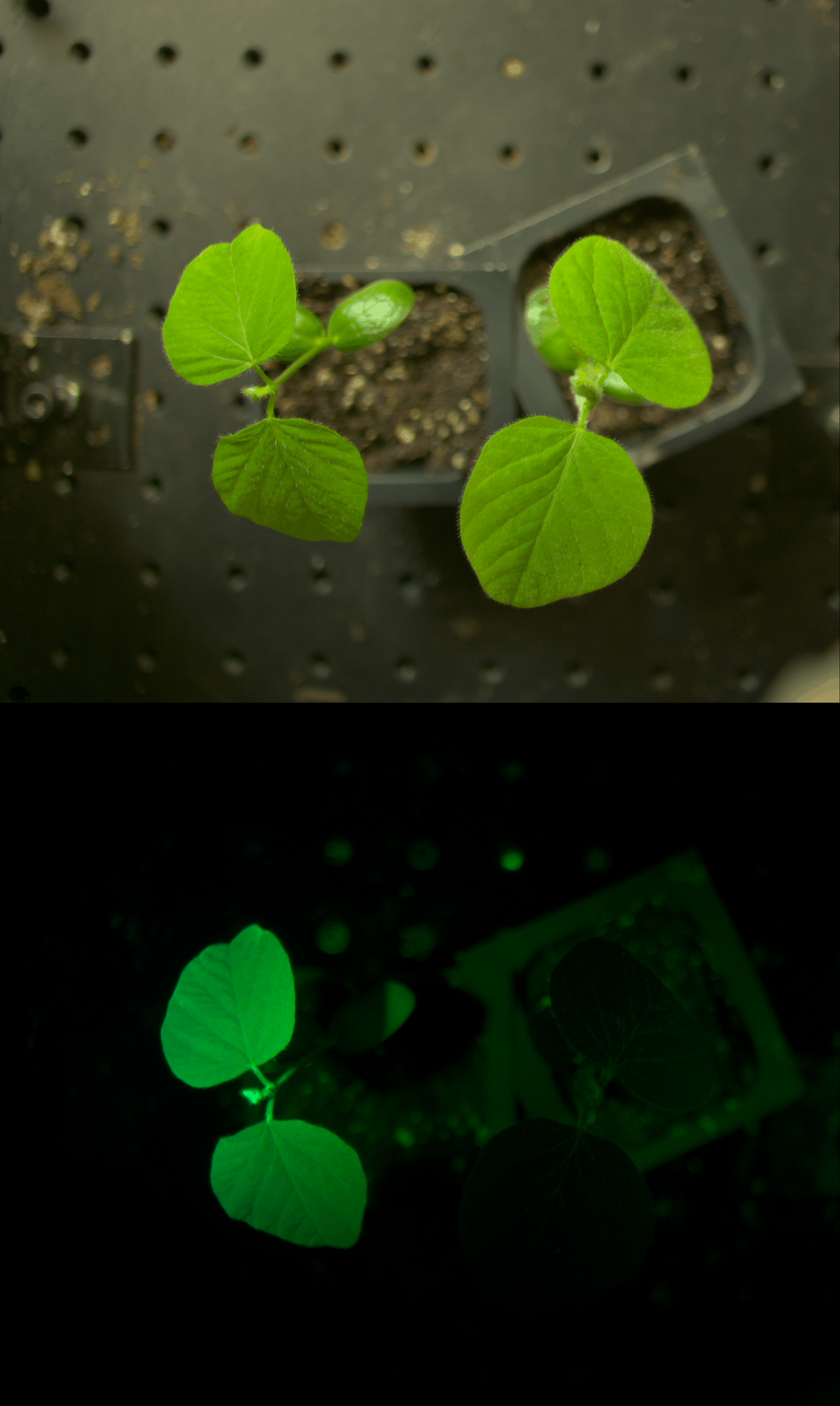
For the first time ever, signals produced by a plant’s physiological response to infection will be linked to optimized crop treatments delivered with John Deere See & Spray(™) technology. Innovative technology allows plants to fluoresce when attacked by fungal pathogens.
DAVIS, Calif. (Nov. 7, 2023) – InnerPlant, the seed technology company enabling the earliest possible detection of stress in crops to make farming universally more efficient and sustainable, Syngenta, a global leader in agricultural innovation and crop protection, and John Deere, a global leader in the delivery of agricultural, construction, and forestry equipment, today announce a joint effort to develop an integrated solution to fight fungus in soybeans. The first-of-its-kind solution will link together plants that give off early and specific signals when under attack by fungus with optimized crop protection treatments that are delivered with See & Spray technology.
“Fungal diseases are a massive and growing problem facing farmers who already face a great deal of risk in their operations,” explains Shely Aronov, CEO and co-founder of InnerPlant. “A solution that links signals directly from plants’ physiological responses to the individualized, precise delivery of optimized inputs will make farmers’ lives easier by delivering both improved efficacy and efficiency.”
Early detection of fungal disease infections is a challenge
Globally, crops are attacked by fungal diseases that result in substantial yield losses. And the problem is getting worse, according to experts who cite climate change and rising resistance to common fungicides as contributing to fast-rising fungal attacks that threaten the world’s food supply and a “global health catastrophe.”
“The technology from InnerPlant allows the detection of plant diseases at the earliest possible stage identifying plant diseases that otherwise often go undetected or untreated,” says Feroz Sheikh, Syngenta’s Chief Information and Digital Officer. “We are happy to engage in these initial trials with our partners. Integrated, innovative solutions are a critical path forward for managing the growing impact of soybean diseases and ensuring that farmers have the tools they need to feed the world.”
Integrated Precision
InnerPlant creates crops that emit specific optical signals when they’re under stress from pathogen attacks, such as fungal infections. Those signals are visible from machines and satellites as much as two weeks before the stress is visible to the human eye at field level. The data from the crop signals provide early warning of an attack at the individual plant level to assist a crop protection specialist in optimizing the use of a Syngenta product for the treatment of the specific need. John Deere’s See & Spray technology allows treatments to be varied and applied only where needed to prevent fungal damage to the crop.
“We are excited to see Syngenta join the efforts to develop a solution to improve customer outcomes, says Dan Leibfried, John Deere’s Director, Corn & Soy Production Systems. “This is the first time we are designing plants, equipment and inputs in an integrated and optimized solution as we work to make farmers more efficient and profitable.”
About InnerPlant
InnerPlant is a team of curious scientists and entrepreneurs creating an innovative new category of seed technology that harnesses plant physiology and unlocks data at scale to boost global agricultural yields and sustainability. The company was founded in 2018 by Shely Aronov and Rod Kumimoto. InnerPlant was recently recognized with a Special Mention TIME Best Inventions and was named a finalist in General Excellence by Fast Company’s World Changing Ideas Awards. For more information visit: innerplant.com.
About Syngenta Group
Syngenta Group is one of the world’s biggest agricultural technology companies, with roots going back more than 250 years. With more than 59,000 employees, operating in more than 100 countries, the company strives to transform food production through Regenerative Agriculture - a science-driven, technology-enabled approach to improve soil, deliver high productivity and high-quality food, help fight climate change and restore lost biodiversity. Syngenta Group, which is registered in Shanghai, China, and has its management headquarters in Switzerland, draws strength from its four business units: Syngenta Crop Protection, headquartered in Switzerland; Syngenta Seeds, headquartered in the United States; ADAMA®, headquartered in Israel; and Syngenta China. Together, these businesses provide industry-leading ways to serve customers around the world. For Syngenta Group photos and videos, please visit the Syngenta Group Media Library.
Media Contact
Sean Yokomizo
Communications/Media Relations
sean.yokomizo@innerplant.com
925.878.1200
###