
July 24th, 2025 Scouting Report for Cedar, Knox, Pierce, Wayne, and Dixon counties in Nebraska and Yankton County in South Dakota
(Scroll down for Illinois counties)
Reported by Tristan Mueller
Disease Risk: 🔴 High for white mold in both irrigated 15” and 30” soybeans
Key Takeaways:
- Disease Alert for Cedar, Knox, Pierce, Dixon, Wayne, and Yankton counties is in effect
- Fields are looking relatively clean from other foliar diseases
Disease Alerts are still in effect, as the CropVoice network currently indicates infection in Cedar, Knox, Pierce, Dixon and Wayne counties and Yankton county in South Dakota.
With most soybeans in the area in late R2 and moving into early R3, this is the last window to apply a fungicide to control white mold. After R3, fungicide efficacy and ROI decreases.
The CropVoice network continues to be monitored daily for common foliar diseases. Fields are looking relatively clean from other foliar diseases (besides white mold) based on scouting and tissue sampling.
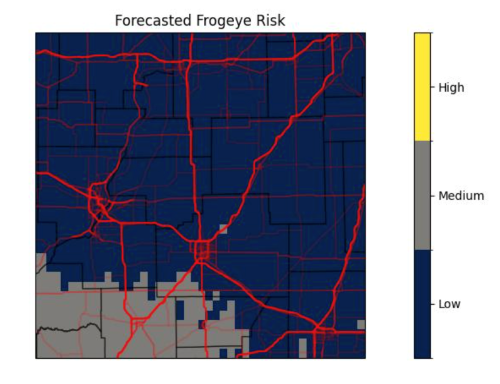
The weather-based frogeye leaf spot forecast has indicated low risk up to this point in the season. We now see some medium risk of frogeye leaf spot creeping in from the east.

Caption: Forecasted frogeye risk for dryland fields for the next 10 days, based on weather modeling. Red lines indicate major roads, with Highway 81 running down the middle of the image; Sioux City at right center.
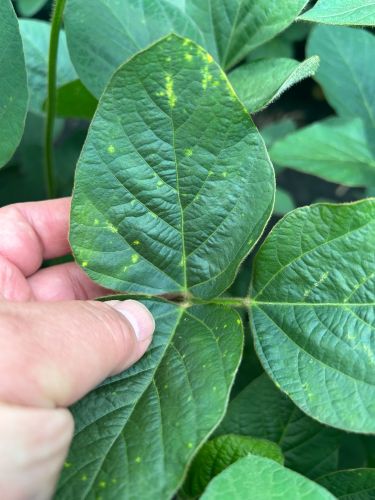
There has been a leaf or two showing symptoms of frogeye leaf spot near one of our sites, but at a level that does not warrant taking action.

Caption: Soybean leaf with frogeye leaf spot
Beyond the low-to-medium risk we are seeing for other common foliar diseases, risk for white mold continues to be high.
Several tissue samples, analyzed through a proprietary CropVoice molecular assay, have tested positive for white mold. This means that white mold spores are in the air while flowers are senescing, when infection can take hold. While infection is beginning now, symptoms in the field will not be visible for several weeks.
Looking at the forecast for white mold, for irrigated beans with 15” row spacing, risk continues to be maxed out at the highest level across the entire region.
For 30” row spacing, the forecast ratchets up the risk to high or medium.
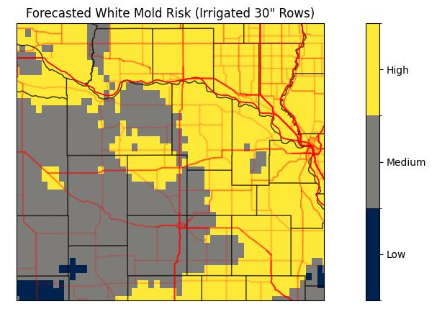
Caption: Forecasted white mold risk on irrigated 30” rows based on weather modeling. Red lines indicate major roads, with Highway 81 running down the middle of the image; Sioux City at right center.
The hot weather through Monday will slow the rate of disease risk progression. However, once we get into the later half of next week, the cooler weather will continue to accelerate the disease progression.
As many are out executing their fungicide plans, the CropVoice Scouting Report will move to a bi-weekly cadence starting next month. We’ll be back in your inbox on August 6th, assuming there is valuable information to share with you.
July 24th, 2025 Scouting Report for Tazewell, Woodford, McLean, Livingston, and Champaign counties in Illinois
Reported by Robert “Bob” Starke, Ph.D.
Disease Risk: 🟢 Low
Key Takeaways:
- Even with recent rains and humidity, the soybean crop is looking healthy with very few symptoms
- Most fields in R4 with early soybeans approaching R5
Most soybean fields in the area are rapidly moving out of R3 and into R4. Some of the earliest planted soybeans are approaching R5. At this point in the season, given what we see across the CropVoice network, we are unlikely to call a Disease Alert for this region.
Even with the recent rains and humidity that might typically foster disease, the soybean crop is looking healthy with very few symptoms. Of the diseases we are seeing in the field, many (like downy mildew and bacterial blight) are not fungi so will not respond to fungicide.
The foliar fungal diseases that have shown up, like Cercospora leaf blight or Septoria brown spot, are not big yield hitters at the levels we are seeing to warrant an application.
This has been a high year for downy mildew (pictured below). You can see the characteristic yellow spot with the white “fuzz” on the bottom of the leaf. Downy mildew is not a fungus (it is an oomycete), so a fungicide application will not have any effect.
Caption: Soybean leaf with downy mildew.
From scouting, it’s clear that the insect feeding looks drastically different between treated and untreated fields. In treated fields, there is much less visible damage from Japanese beetles on the top trifoliates. While the feeding from Japanese beetles looks bad, the current level of damage is not close to the economic threshold to warrant another spray.
Over the next ten days, the change in frogeye leaf spot risk increases by about 4%. We have been talking about slow, steady increases in frogeye risk these past few weeks. Now, the southwest area of Bloomington has inched up to ‘medium’ risk for frogeye leaf spot for the first time this year (gray area in picture below).
Caption: Regional forecasted frogeye leaf spot disease risk based on weather, leaf moisture, and other variables. For reference, Bloomington is just south of the center of this map, and Peoria west of center. I-39 runs through the center of the map. (Source: InnerPlant modeling based on the work of Damon Smith at the University of Wisconsin)
The CropVoice Scouting Report will move to a bi-weekly cadence starting next month. We’ll be back in your inbox on August 6th, assuming there is valuable information to share with you.
Catch up with any scouting reports you missed by following the links below:
Scouting Report for July 17, 2025
Disease Alert for July 11, 2025
Scouting Report for July 10, 2025
Scouting Report for July 3, 2025
Scouting Report for June 26, 2025
Scouting Report for June 12, 2025
Scouting Report for May 29, 2025
Scouting Report for May 15, 2025