

August 7, 2025 Scouting Report for Cedar, Knox, Pierce, Wayne, and Dixon counties in Nebraska and Yankton County in South Dakota
(Scroll down for Illinois counties)
Reported by Tristan Mueller
Disease Risk: 🔴 High
Key Takeaways:
- As soybeans advance past the R3 growth stage, the ROI of a fungicide pass for white mold or for foliar disease control decreases substantially.
- There is growing frogeye leaf spot disease pressure, which will be something to keep an eye on for 2026 as the pathogen survives overwinter in debris.
- White mold symptoms are showing up in farmers’ fields in NE Nebraska.
Soybeans in the area are into R4 with some nearing R5. At this point in the season, additional fungicide applications begin to lose their economic edge. While a “revenge application” might feel good, it likely won’t deliver a return on your investment.
Throughout this season, you’ve heard us discuss the high white mold risk and the CropVoice Disease Alert was triggered from white mold infection back in July. Now, confirmed white mold disease symptoms are showing up all across eastern Nebraska.
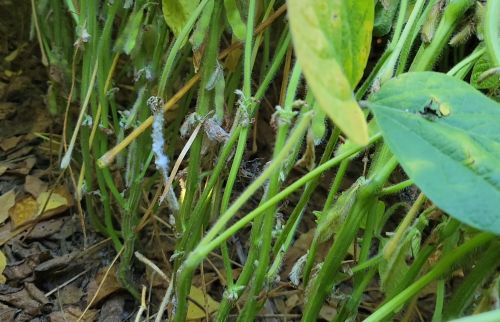
Caption: White mold symptoms are beginning to show up. (Photo credit: Dylan Mangel)
As the season has progressed, we are now seeing some frogeye leaf spot at most of the Nebraska CropVoice plots. Our frogeye disease forecasts indicate a medium risk east of Highway 81 and north of Sioux City (gray areas in the map below).
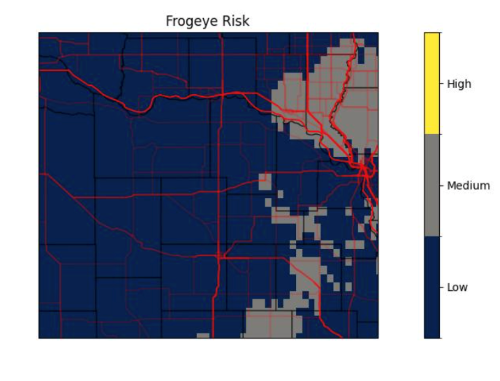
Caption: Current frogeye risk for dryland fields, based on weather forecasting. Red lines indicate major roads, with Highway 81 running down the middle of the image; Sioux City at right center.
The risk level the models line up well with what we are seeing in the CropVoice plots and disease scouting. We have been seeing symptoms (the “frogeye” lesions) on a few leaves. Expect the disease pressure to build over the coming weeks.
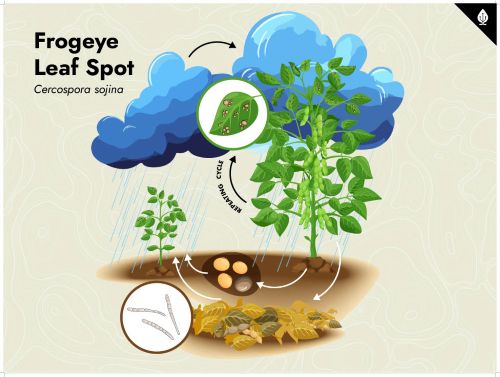
Caption: This diagram shows the lifecycle of frogeye leaf spot (Cercospora sojina). The fungus survives overwinter in crop residue. When it rains, spores are splashed up onto foliage, where it creates lesions that release spores and repeats the cycle.
While this level of frogeye disease pressure at this point in the season will likely not be ROI-positive to spray, it’s important to note that the frogeye leaf spot pathogen survives over winter in debris. Since last year (2024) was a relatively low-pressure year for frogeye leaf spot, there wasn’t a heavy pathogen load as we entered this season.
Now, looking ahead to 2026, if next year’s conditions are favorable for frogeye leaf spot (another high moisture year, for example), your soybean crops will need to be monitored closely since there is inoculum building today that will overwinter in debris. The CropVoice network will be expanded in your area next year, to alert you of frogeye leaf spot, white mold, or other foliar diseases early so you can take action.
August 7, 2025 Scouting Report for Tazewell, Woodford, McLean, Livingston, and Champaign counties in Illinois
Reported by Robert “Bob” Starke, Ph.D.
Disease Risk: 🟠 Medium
Key Takeaways:
- Beginning to see symptoms of sudden death syndrome, especially in early-planted and early-maturity group soybeans.
- Seeing symptoms of light infestation of frogeye leaf spot and models indicate medium risk, but fungicide application this late will likely not be ROI-positive.
Recent rains have driven late-season growth and yield potential.
We are starting to see symptoms of sudden death syndrome (SDS). SDS is most visible in soybeans that were planted early and in the earlier maturity groups. Typical symptoms are yellowing and browning between the leaf veins, like the picture below.
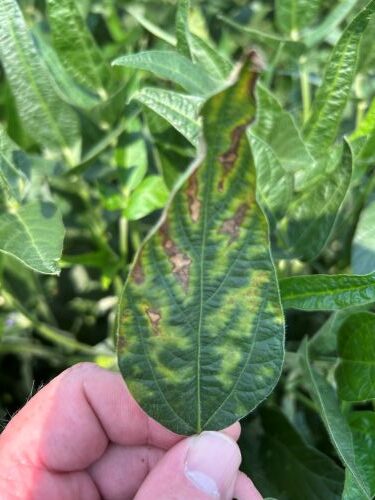
Caption: A soybean leaf showing symptoms of sudden death syndrome.
Our frogeye leaf spot disease forecast is indicating medium risk throughout most of the region (the gray areas in the map below):
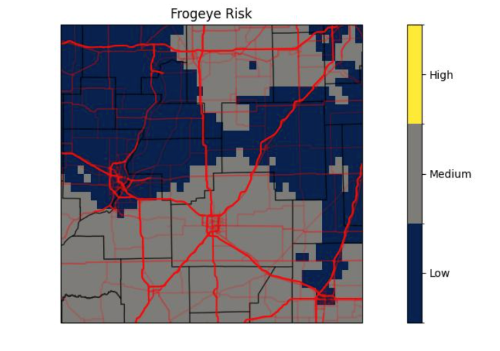
Caption: Current frogeye risk based on weather forecasting. Red lines indicate major roads, with I-39 running through the center of the map. Bloomington is just south of the center of this map, and Peoria west of center.
We are seeing some light infestations of frogeye leaf spot in the field. At this point in the season, and given the light severity of the disease, any additional fungicide application will likely not be ROI-positive.
Caption: This diagram shows the lifecycle of frogeye leaf spot (Cercospora sojina). The fungus survives overwinter in crop residue. When it rains, spores are splashed up onto foliage, where it creates lesions that release spores and repeats the cycle.
It’s important to note that the frogeye leaf spot pathogen survives over winter in debris. Since last year (2024) was a relatively low pressure year for frogeye leaf spot, there wasn’t a heavy pathogen load as we entered into this season.
Now, looking ahead to 2026, if next year’s conditions are favorable for frogeye leaf spot (another high moisture year, for example), your soybean crops will need to be monitored closely since there is inoculum building today that will overwinter in debris. The CropVoice network will be expanded in your area next year, to alert you of frogeye leaf spot or other foliar diseases early so you can take action.
Catch up with any scouting reports you missed by following the links below:
Scouting Report for July 24, 2025
Scouting Report for July 17, 2025
Disease Alert for July 11, 2025
Scouting Report for July 10, 2025
Scouting Report for July 3, 2025
Scouting Report for June 26, 2025
Scouting Report for June 12, 2025
Scouting Report for May 29, 2025
Scouting Report for May 15, 2025